The Problem
AI assistance (Shen & Tamkin, 2026)
independent reasoning (Lee et al., 2024)
When does AI build understanding, and when does it just replace thinking?
Cognitive Science Grounding
Hutchins
Distributed Cognition: who's doing the cognitive work, student or AI?
Flavell
Metacognition: is the student monitoring their own thinking?
Gentner
Structure-Mapping: did they learn deep structure or just surface features?
Together: a complete diagnostic picture of who's thinking, self-awareness, and transfer.
The Diagnostic Tool
React + Hono + Claude. Each student completes three stages under one of three AI conditions.
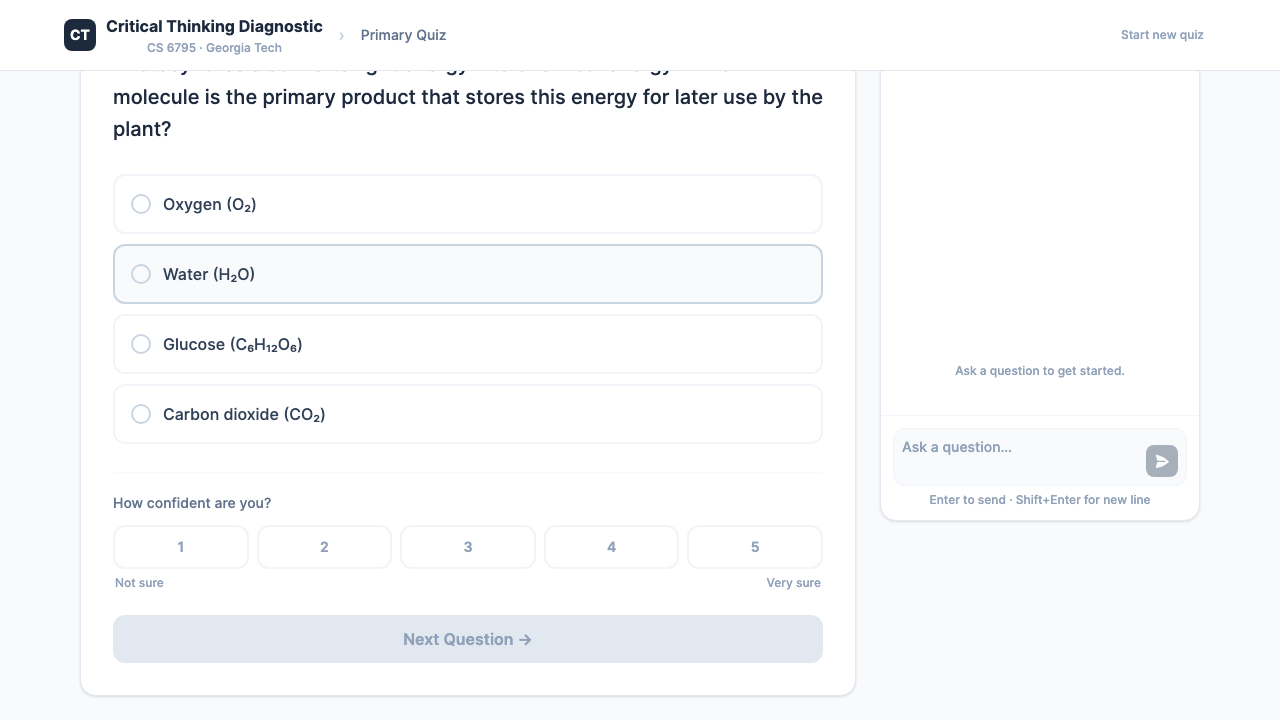
1. Primary Quiz
8 questions with optional AI chat
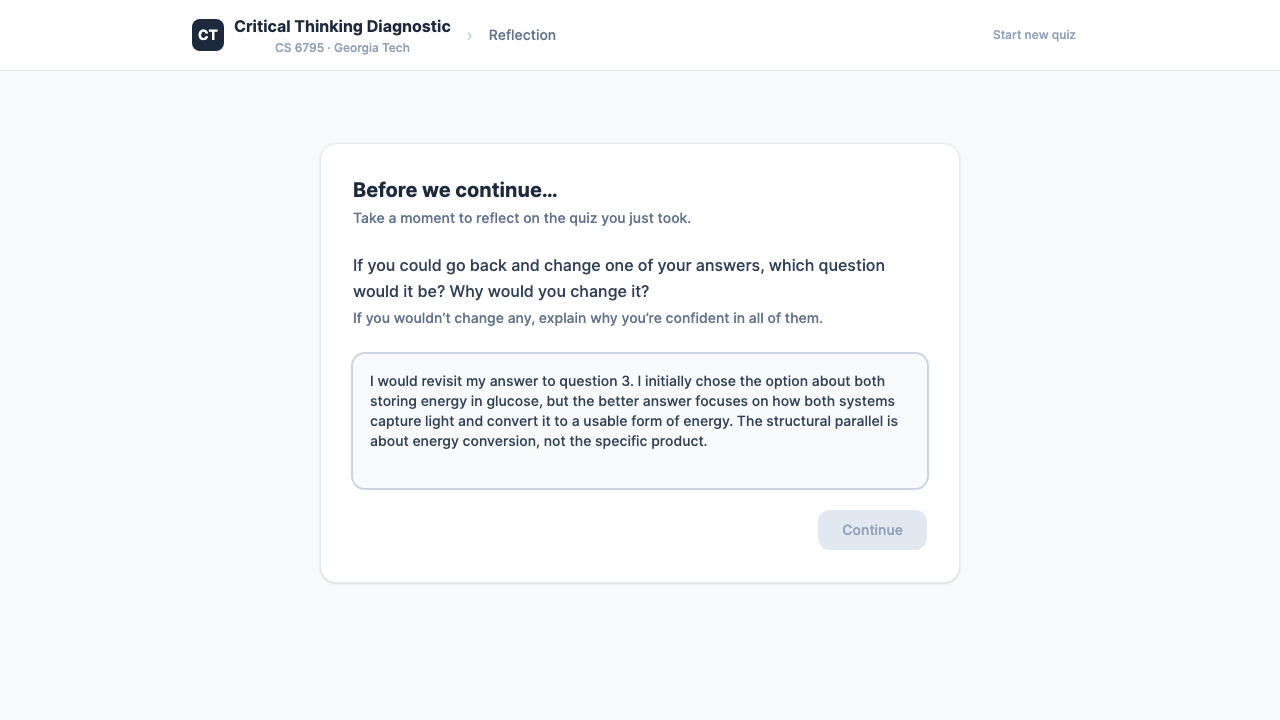
2. Reflection
Metacognitive self-regulation prompt
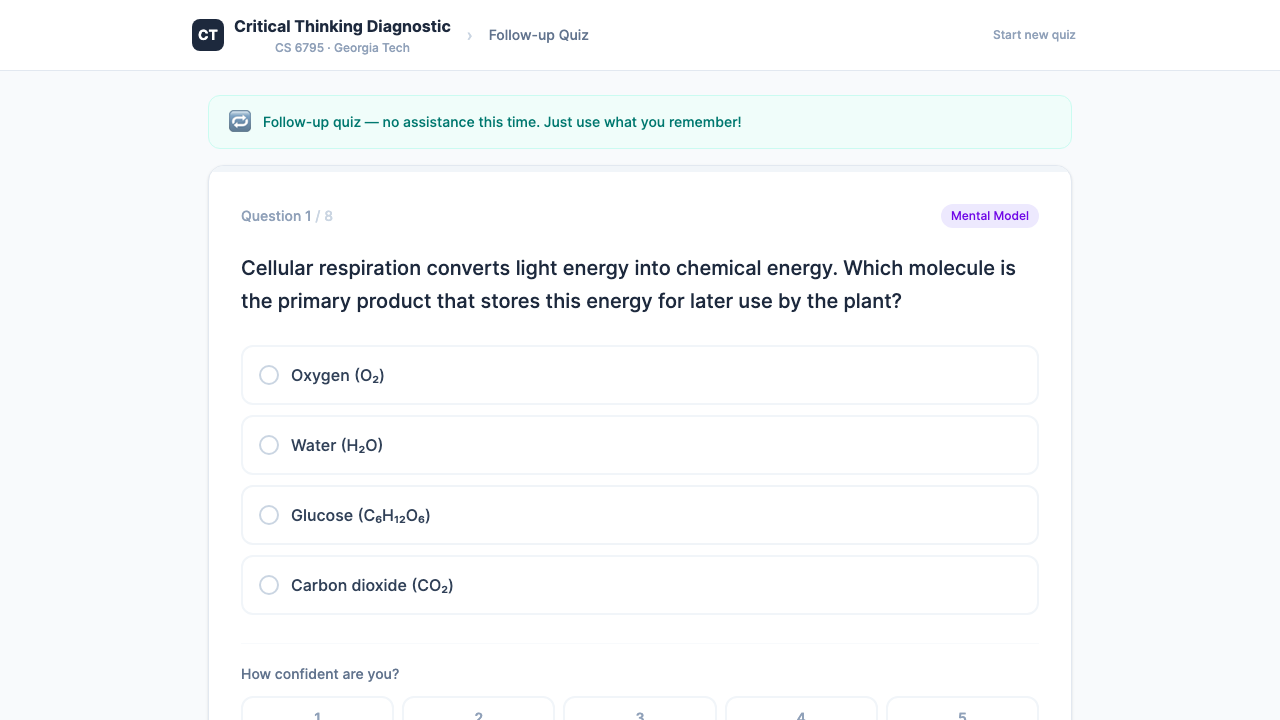
3. Transfer Quiz
Same structure, new surface features
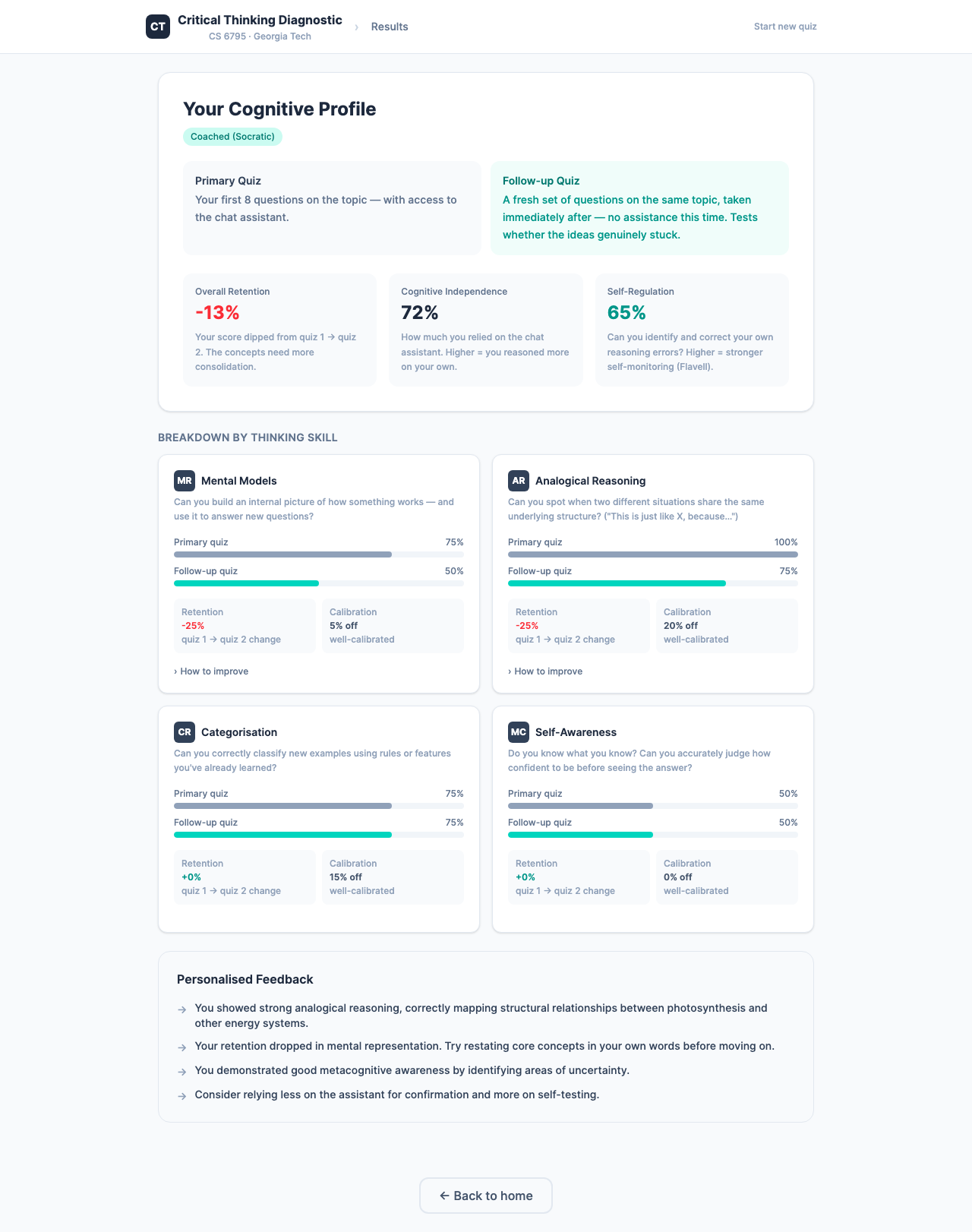
Diagnostic Profile
Four cognitive dimensions scored across primary and transfer quizzes.
Three Conditions
A — Control
No AI assistant
B — Socratic
Guiding questions only
C — Unrestricted
Full AI answers
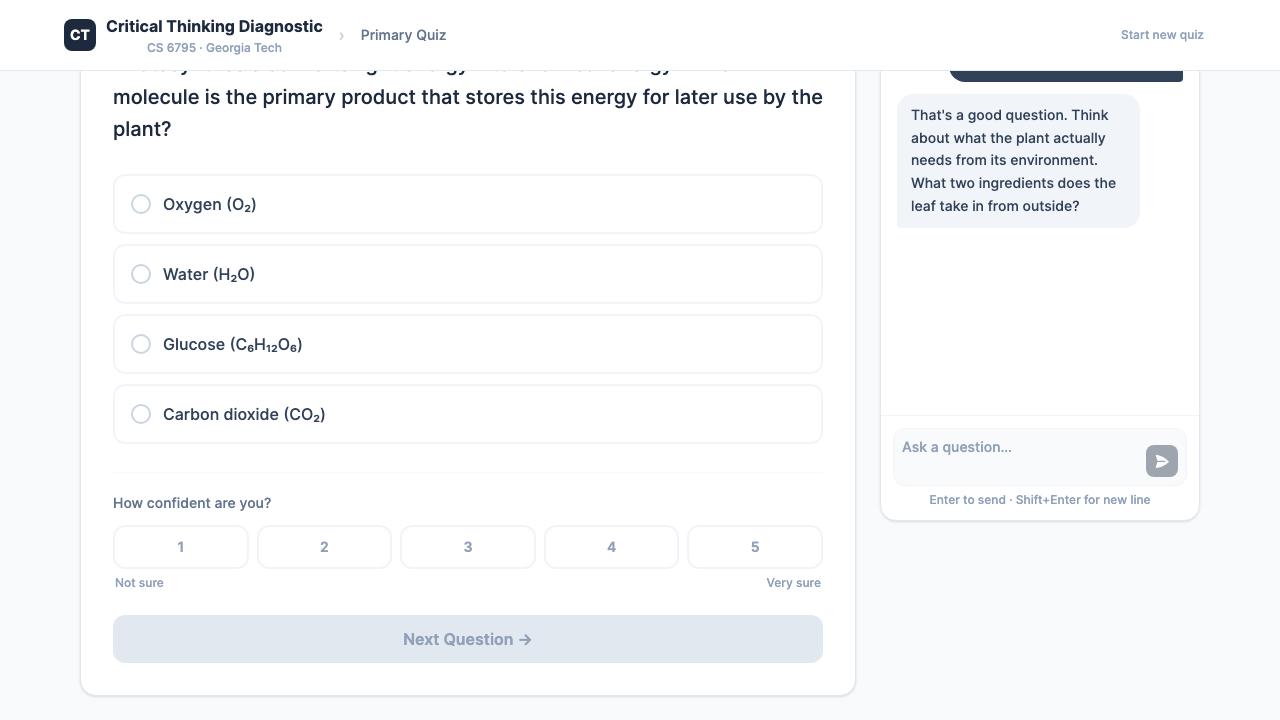
Condition B: Socratic Coach
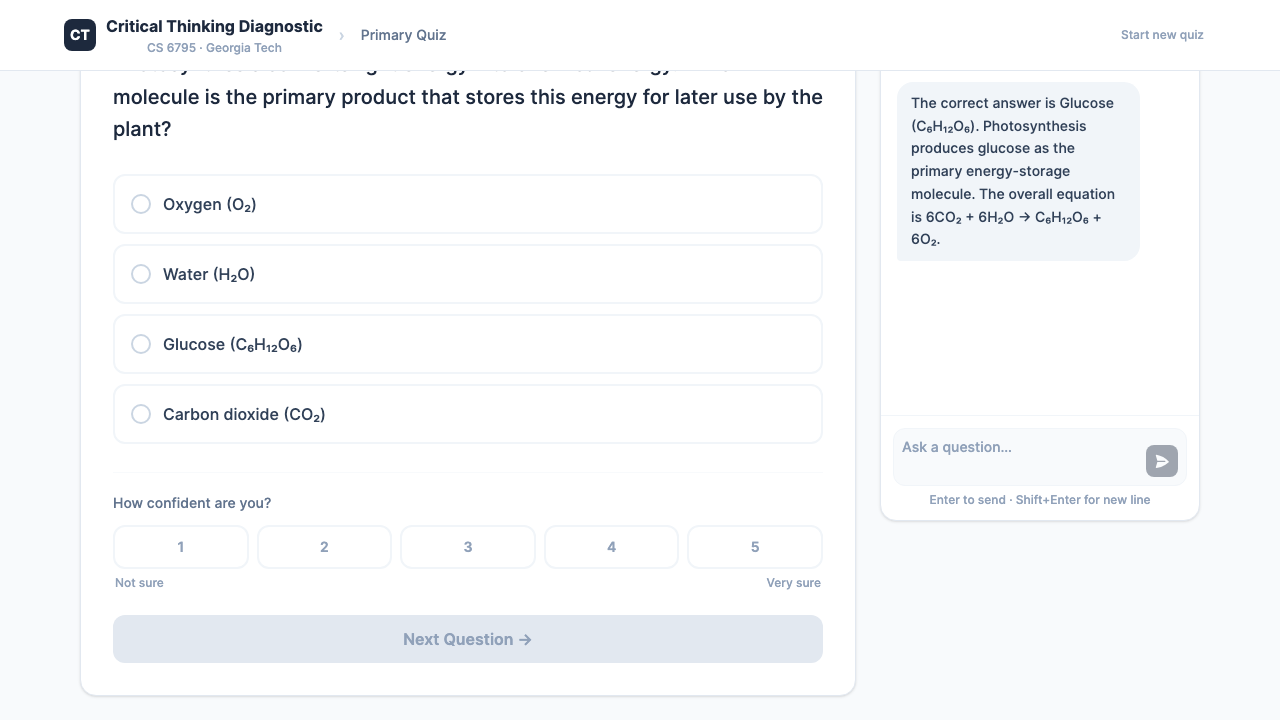
Condition C: Unrestricted AI
Three Measurement Channels
Chat Classifier → Hutchins
Scores every message for cognitive independence
Reflection Rubric → Flavell
Scores self-regulation between questions
Transfer Quiz → Gentner
Structure-mapped follow-up measures retention
Reflection interstitial (Flavell)
Transfer follow-up quiz (Gentner)
Four Learner Archetypes
Synthetic personas used to simulate 60 sessions (4 archetypes × 3 conditions × 5 runs).
Deep Learner
Reasons from first principles. High accuracy, well-calibrated confidence. Recognizes deep structure on transfer tasks. Rarely uses AI for answers.
Surface Memorizer
Relies on keyword matching. High confidence but poor calibration. Struggles when surface features change. Heavy AI usage in condition C.
Overconfident Guesser
Goes with gut instinct. Consistently overestimates understanding. Flat retention because no deep learning to lose. Ignores AI coaching.
Metacognitively Aware
Average knowledge but strong self-monitoring. Highly calibrated confidence. Maintains or improves on transfer. Uses AI strategically to fill gaps.
Retention by Condition
(pooled, 95% CI ±7pp)
(near baseline)
from deep learners (any condition)
Cognitive Independence & Retention
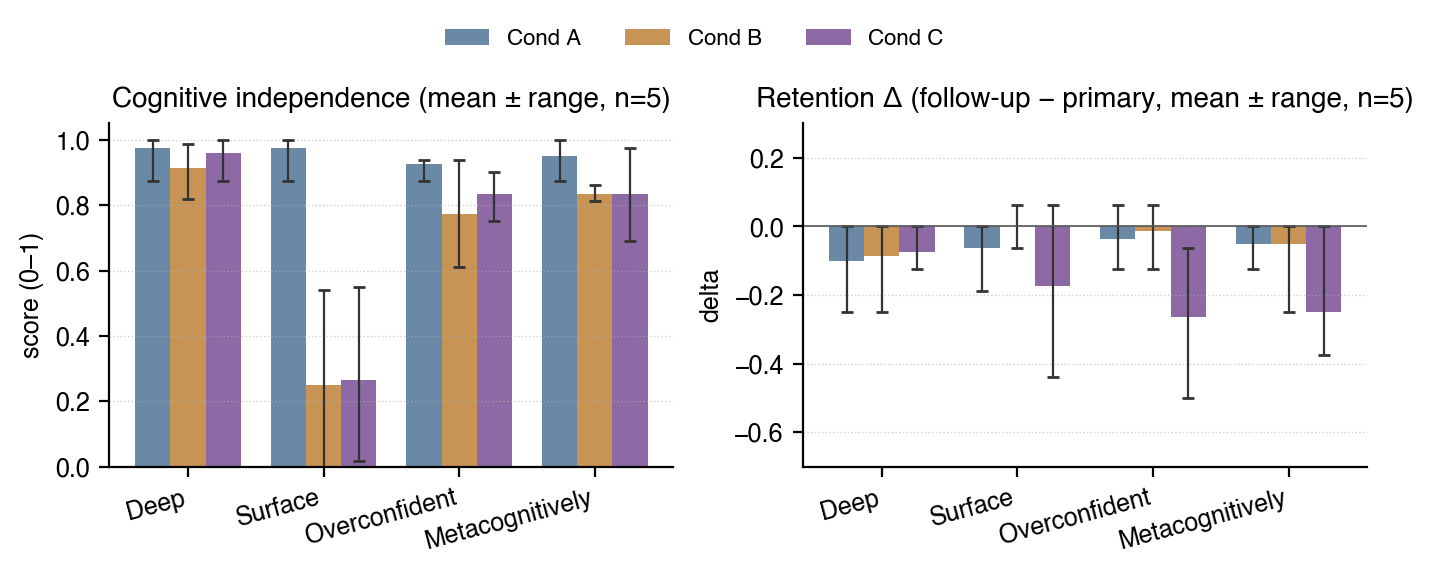
Deep learners maintain independence and are buffered. Surface memorizers offload and lose the most.
Chat Behavior by Learner Type
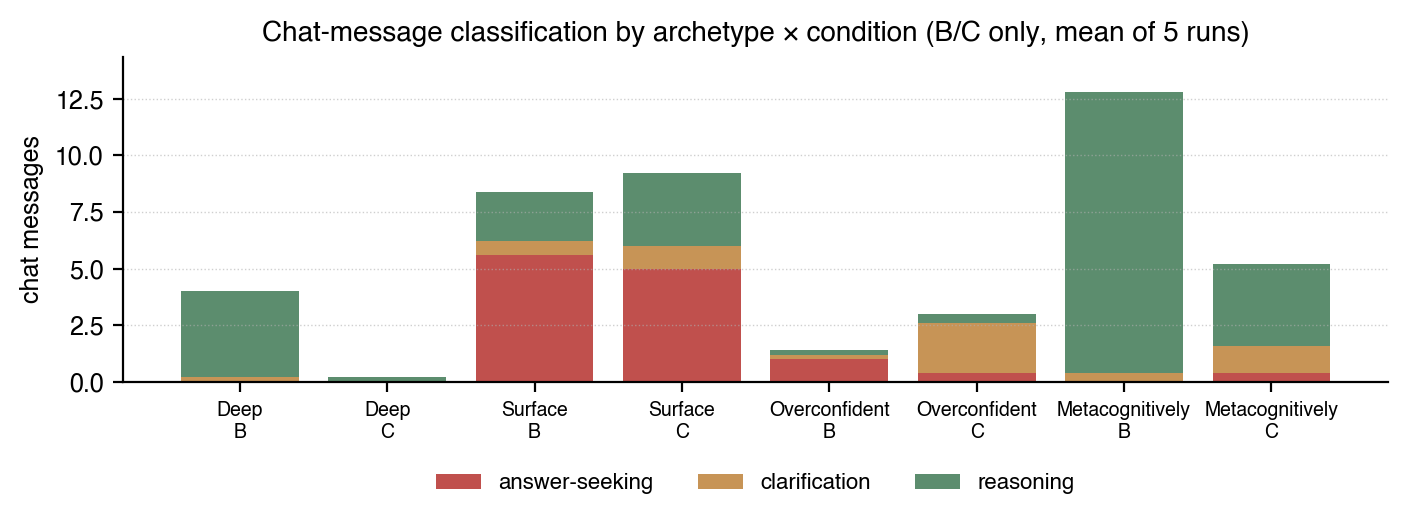
Surface memorizers send 5–6 answer-seeking messages; deep learners send zero.
External Validation
vs. CIMA human-coded corpus
ReflectSumm human labels
with GPT-5
Key Takeaways
AI is not the enemy. Offloading is. Socratic coaching was as safe as no AI at all. The problem is handing over thinking before articulating it yourself.
Measure independence, not just performance. 100% with heavy AI help is not the same as 90% independently.
Use transfer tasks. A single quiz score doesn't reveal whether understanding is genuine.
Future Work
- Validation with real K-12 students
- Longitudinal tracking of diagnostic profiles
- Adaptive systems matching AI mode to learner needs
Thank you
Abhinav Kishore • akishore33@gatech.edu